


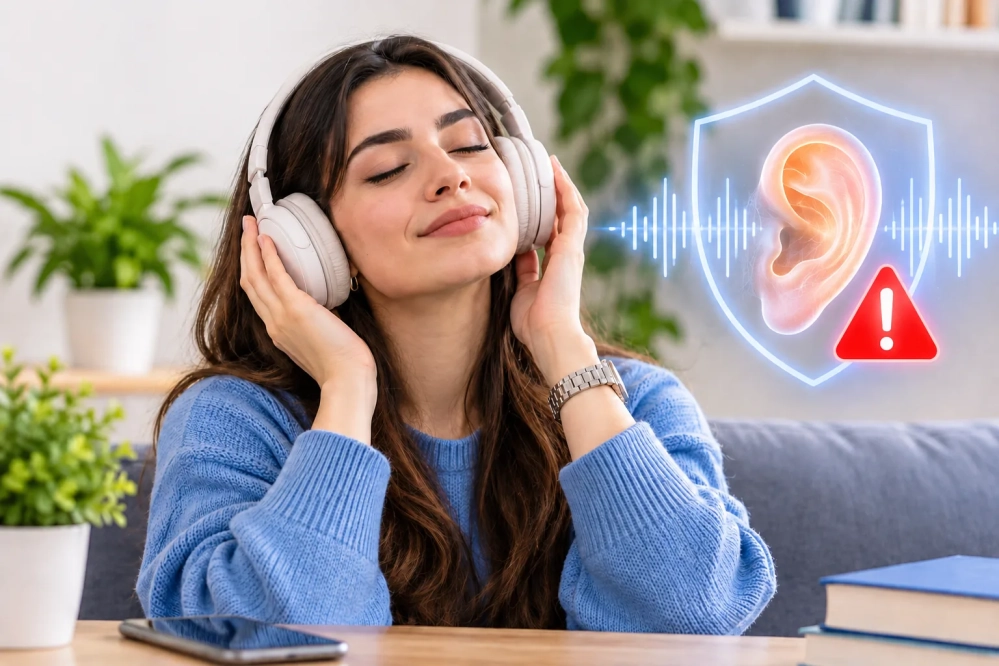
How Does Long-Term Headphone Use Affect Hearing? – Ways to Protect Your Hearing Health
Headphones have become an essential part of our daily lives. We use them to listen to music, watch movies, and make phone calls. However, using headphones for long periods at high volume can have a serious impact on hearing health.
This habit is particularly widespread among young people. Unfortunately, many people notice changes in their hearing too late. However, noise-induced hearing damage can be permanent in some cases.
So, how do headphones affect hearing? What volume level is considered dangerous? What should we pay attention to in order to protect our hearing?
In this blog, we explore all the important aspects in detail.
How Does Headphone Use Affect Hearing?
Our ears receive sounds and convert them into nerve signals. Sensitive hair cells located in the inner ear play an important role in this process.
However, loud sounds can damage these cells. Long-term exposure to noise can weaken their function. As a result, a person may no longer hear certain sounds as well as before.
In addition, continuous exposure to loud sounds can lead to the following problems:
- Reduced hearing sensitivity;
- Ringing or whistling sounds in the ears;
- Difficulty understanding speech;
- Reduced ability to hear in noisy environments;
- Temporary or permanent hearing loss.
The most concerning aspect is that hearing damage can develop gradually. A person may not notice these changes during the early stages.
How Dangerous Is Listening to Music at High Volume Through Headphones?
One of the main factors affecting hearing health is sound intensity. Sound intensity is measured in decibels (dB).
The World Health Organization provides important recommendations for safe listening. These recommendations consider both sound levels and listening duration.
Sound Levels and the Risk to Hearing
60 dB — Relatively low level
A sound level close to that of a normal conversation.
80 dB — A safer level
According to WHO recommendations, listening at this sound level for up to 40 hours per week is possible.
90 dB — Increased risk
The recommended safe listening duration decreases significantly.
100 dB — High risk
Even short-term exposure to this sound level can be dangerous for hearing.
Important: These figures are general guidelines. Individual risk depends on the intensity and duration of sound exposure, as well as other factors.
The WHO safe listening recommendations use 80 dB as an example, indicating that exposure at this level can be limited to up to 40 hours per week. When the sound level reaches 90 dB, the recommended duration decreases to just 4 hours.
This means that the higher the sound intensity, the shorter the safe exposure time for your ears.
Main Signs of Hearing Deterioration Caused by Headphone Use
Noise-induced hearing loss does not always occur suddenly. On the contrary, symptoms often develop gradually.
The following changes may be observed during the early stages:
- Difficulty understanding the other person during phone conversations.
- The need to increase the volume of the television or phone.
- Persistent ringing, buzzing, or whistling sounds in the ears.
- Hearing people speak but having difficulty distinguishing their words.
- Difficulty following conversations in noisy environments.
- Reduced ability to hear certain high-frequency sounds.
The World Health Organization recommends paying attention to these symptoms. Persistent ringing in the ears, in particular, is an important sign that a hearing assessment may be necessary.
7 Important Rules for Safe Headphone Use
Protecting your hearing health can start with changing a few everyday habits. Follow the recommendations below:
1. Do not increase the volume above 60%.
Try not to exceed 60% of your phone's maximum volume. This can help reduce the risk of exposure to excessively loud sounds.
2. Limit your listening time.
Avoid listening to music continuously for long periods. Take regular breaks to give your ears time to rest.
3. Do not increase the volume in noisy environments.
Avoid turning up your music on the metro, bus, or street. Instead, choose headphones with noise-isolating features.
4. Choose high-quality headphones.
Use models that fit your ears properly and reduce external noise. This choice can help you listen to music at a lower volume.
5. Do not use headphones while sleeping.
Sleeping with headphones may increase the duration of sound exposure. It can also prevent your ears from getting proper rest.
6. Activate sound notifications on your phone.
Many smartphones allow you to monitor volume levels and listening time. Make regular use of these features.
7. Have your hearing checked.
Pay attention to your hearing health even if you do not have any complaints. If you are used to listening to music at high volumes for long periods, do not delay your hearing assessment.
These recommendations are based on the WHO safe listening principles.
Why Is a Hearing Assessment Important?
In the early stages, hearing deterioration may not cause serious difficulties in everyday life. This is why many people postpone getting their hearing checked.
However, early detection makes it possible to assess hearing condition in a timely manner. An audiological assessment helps evaluate hearing sensitivity across different frequencies.
During the assessment, an audiologist evaluates hearing levels. Based on the results, the need for additional testing and appropriate support can be determined.
It is particularly important to seek an assessment in the following situations:
- If you frequently experience ringing in your ears;
- If you have difficulty understanding speech;
- If you are used to listening to music at high volumes;
- If you increase the volume of your phone or television;
- If people close to you often point out that you have difficulty hearing.
If you experience sudden hearing loss, do not wait. Seek urgent medical evaluation.
Free Hearing Assessments at Avaz Hearing and Speech Center
Do not postpone your hearing assessment. Take care of your hearing health!
Avaz Hearing and Speech Center places special importance on evaluating hearing health.
At our center, hearing levels are checked through audiological assessments. Professional specialists evaluate the results and provide appropriate guidance.
In addition, free audiological assessments are conducted at our branches on Saturdays by prior appointment.
Take advantage of this opportunity to have your hearing checked. Contact us for more information about free assessments and appointment requirements.
Avaz Hearing and Speech Center
012 311 20 18
Baku — Ganjlik, Ahmadli, and Khatai branches.
Prior registration is required for a free hearing assessment.
Conclusion: Start Protecting Your Hearing Health Today!
Using headphones is not inherently dangerous. The main risk comes from high volume levels and the habit of listening to music for extended periods.
Remember that protecting your hearing starts with the choices you make every day. Control the volume, take regular breaks, and do not postpone your hearing assessments.
At Avaz Hearing and Speech Center, our goal is to support everyone in hearing the sounds around them better. Because every sound matters! ❤️